




Introduction
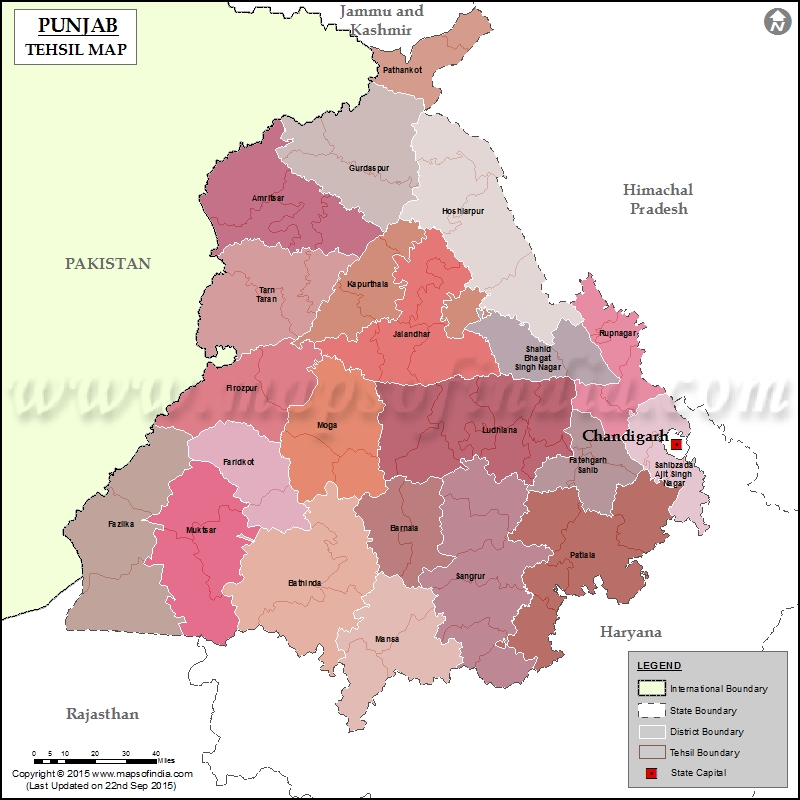
The Indian state of Punjab administrative set up is modeled so as to provide good governance, efficient provision of public services, and equitable development of the regions. The key sub-district unit of this system of administration is tehsils. Tehsils are an intermediary between the administration of the districts and the rural and urban communities within their scope of jurisdiction. They are very instrumental in land management, collection of revenue, coordination of law and order and execution of government welfare programs.
The Tehsils in Punjab are not just bureaucratic units, but they indicate the social, cultural and economic diversity in Punjab. The tehsils consist of several towns, villages and farming areas that advance the local economy. Most government offices including the office of tehsildar, the revenue courts, and land record departments are located in the tehsil headquarters. The duties of these offices include keeping land ownership records, dispute resolving, revenue collection and development programmes coordination.
Punjab is today divided into 23 districts including Ludhiana, Amritsar, Jalandhar, Patiala, Bathinda among many others. The districts house several tehsils which deal with local administration issues. With time, the tehsils have been increasing with the state government establishing new administrative units in a bid to enhance governance and accessibility to the citizens.
The importance of tehsils is specifically felt in the rural areas where agriculture has been the mainstay of the economy. Because of its agricultural productivity, Punjab is usually referred to as the Granary of India. The majority of the villages are structured around the tehsil administration which deals with land records, irrigation problems, and revenue in agriculture. With such functions, tehsils aid in the economic activity and rural governance.
History of Tehsils in Punjab
The idea of tehsils in Punjab dates back to the centuries past. The administrative divisions were also structured during the time of the Mughal Empire so as to create efficient system of taxation and ruling. These divisions were transformed into organized revenue units which in turn spilled over to the development of modern tehsils.
This system was further perfected when the region was put under the domain of the British Raj in the nineteenth century. Primary administrative units were formed and those were districts and sub-units were called tehsils whose role was to manage the revenue and take care of the land records. British officers also brought about elaborate survey and documentation practices that are still used in the administration of land in India.
When India got its independence in 1947, India was left with much of the colonial administrative structure but made changes to suit the democratic rule. With an increased population and administrative demands, gradually new districts and tehsils were established in Punjab by the state government. This was done to enhance accessibility and get the government services nearer to citizens.
The administrative map of Punjab has varied in a number of ways throughout the decades. Fazilka and Pathankot were new districts, and new tehsils were constituted in them. These transformations are a reflection on changing demographic, economic and political environment of the state.
Administrative Position and Administration
The tehsils are the main administrative units of land and revenue in Punjab. A government official called Tehsildar heads each tehsil and undertakes the responsibility of overseeing the process of revenue collection, keeping land records and enforcing government regulations on the ground. The Tehsildar under the district administration is in collaboration with other officials including the Sub-Divisional Magistrate and the District Collector.
Among other things, the management of land records is one of the most crucial functions of a tehsil office. In a state such as Punjab where agriculture is the major occupation, it is imperative that right land documentation takes place. Farmers use official records to verify ownership, crop loan, inheritance and transfers. These aspects are monitored in tehsil offices by detailed registers and computerized records.
Another huge role played by tehsil administrations is revenue collection. The concept of tehsils was created historically in the Mughal and the British times when an effective system was required to collect the taxes on land. The tehsil nowadays has its revenue department which continues to collect taxes on agricultural lands, property registrations and stamp duties. These are finances that are used in administration and development of the state.
Tehsils are also involved in ensuring that there is law and order in addition to their revenue functions. The Sub-Divisional Magistrate who happens to be related to the same geographical location as a tehsil or a cluster of tehsils collaborates with local police officials to maintain stability and safety. This structure enables the district administrations to act fast in times of emergencies, conflicts and social issues.
There are also many public services that are offered in tehsil offices. Income certificates, caste certificates, domicile certificates as well as land mutation records are some of the documents that citizens visit these offices. As government services are increasingly being digitised, online systems have become common in several tehsil offices in Punjab to facilitate the process and minimise bureaucratic process delays.
Major Tehsils Across Punjab
The districts of Punjab are full of tehsils that are the distinct geographical and socio-economic areas. Indicatively, Amritsar district comprises notable tehsils that are Amritsar-I, Amritsar-II, Baba Bakala and Ajnala. These tehsils govern the urban centres as well as rural villages around the historic city which is widely known world wide due to Golden Temple.
Ludhiana tehsils include Ludhiana East, Ludhiana West, Khanna, Jagraon, Payal and Samrala which are found in the district of Ludhiana. Ludhiana is commonly referred to as an industrial hub of Punjab and its tehsils have to deal with not only large urban areas but also agricultural areas too. The land, industry and urban development issues are under the administrative offices here.
Likewise, the tehsils of the district of Jalandhar are the Jalandhar-I, Jalandhar-II, Nakodar, Shahkot and Phillaur. These regions are part of the Doaba region that lies between Beas River and Sutlej River. It is also rich in fertile soil with a high level of agricultural productivity, and the number of diaspora.
In southern Punjab, tehsils, such as Bathinda, Talwandi Sabo, and Rampura Phul can be found in the Bathinda district. These tehsils are in charge of large agricultural estates not to mention the urban sprawl of industrial and thermal power projects. There are also ancient forts and religious places, which make the area historically significant.
Economic and Social Significance
In Punjab, the tehsils are closely related to agriculture and rural development as far as their economic importance is concerned. The state is also a large producer of wheat and rice and much of this production takes place in villages which are run through tehsil offices. The tehsil officials are often coordinated with the village authorities in the areas of agricultural planning, irrigation management and keeping of crop records.
Tehsils are also significant in carrying out welfare schemes by the government. The tehsil level is usually the one that monitors programmes associated with rural employment, housing assistance, food distribution and agricultural subsidies. Tehsil authorities are also in a position to disseminate government policies to communities by acting as intermediaries between the district administration and the village panchayats.
Tehsils also in one way come under the administrative responsibility of urban development. Expanding cities such as Mohali and Amritsar have been experiencing a fast growth in the recent decades. In these growing areas, tehsil offices are used to control land dealings, registering of property and planning of infrastructure.
Socially, tehsils also help in ensuring access to administration to the citizens. Residents will also access various services in addition to travelling to the district headquarters when they need every official process instead of traveling to nearby tehsil offices. This decentralised organisation saves time and makes the governmental processes more convenient to the people.
Emerging Technologies and Online Governance.
During the last few years, the Punjab government has also put up modern technologies aimed at enhancing the operations of the tehsil administrations. There is the emergence of digital land record systems, online property registration, and electronic service portals that have changed the manner in which citizens relate to the government offices to a great extent.
Among these efforts is the digitalisation of land records where farmers and property owners can find official records online. Such a system minimizes the possibility of land documentation and entry errors or manipulation, and simplifies the process of verifying ownership information by banks and institutions.
Integrated service centres have also been established whereby tehsil offices have been integrated where citizens can access various government services at a single position. Through these centres, there is less burden on the administrative system and the necessity to visit various departments many times. Consequently, the governance has become clear and more effective.
Moreover, the growth of infrastructure and transport systems in Punjab has enhanced accessibility of the tehsil headquarters to rural villages. The connection between the local communities and the administration has been enhanced due to the improved road systems, transportation systems, and digital communication.
Conclusion
Tehsils are an inherent tier of government in the administration of Punjab. Through the sub-district units, they ease the administration of land records, collections of revenue, community services, and development programmes. In the rural and urban regions, citizens can have access to administrative processes because of their presence.
Tehsils are not just important in bureaucratic administration. They are the local form of governance that sustains the agricultural economy, social welfare and also the development in the Punjab region. Since the time of keeping records of farmland management to the supervision of public records, tehsil offices are still at the center of day-to-day government in the state.
Tehsils have a long history, and were created in the administrative systems of the Mughal and colonial India. They now integrate digital technologies and systems of integrated services so as to offer quick and transparent services to the citizens.
The role of tehsils is bound to be significant in Punjab as the state keeps on expanding economically and in terms of population. As the administrative reforms are underway and there are technological improvements that may happen, these units will always be the pillars to local governance whereby the government policies and services will reach the people of the state effectively.
Last Updated on : May 08, 2026
